
Last updated July 10, 2026
The Complete Guide to Air Duct Cleaning in Cincinnati
Most Cincinnati homes William Davis has inspected have ductwork that hasn’t been cleaned since the HVAC system was installed — often 10–20 years ago — yet the homeowners received “clean bill” postcards from franchise crews who never pulled a single register. In 14 years of working inside Greater Cincinnati duct systems, from Norwood bungalows to Hyde Park colonials, we’ve learned that local climate conditions create contamination patterns national guides completely miss. This guide translates thousands of hands-on Cincinnati jobs into what you actually need to know: how our humid summers and heavy pollen seasons affect your ducts, why older neighborhood housing stock demands different approaches, and how to tell whether a cleaning was thorough or merely surface-level.
Quick Answer
Professional air duct cleaning in Cincinnati typically costs between $400 and $900 for a standard single-family home, with full source removal cleaning taking 3–5 hours using negative air pressure equipment. Cincinnati’s humid subtropical climate — combined with pollen-heavy springs and legacy ductwork in neighborhoods like Norwood, Oakley, and Hyde Park — accelerates mold growth and particulate buildup compared to drier Midwestern markets. A legitimate cleaning requires sealed HEPA containment, agitation tools that reach the full duct run, and post-cleaning verification; anything less leaves significant contamination behind.
Table of Contents
- How Cincinnati’s Climate Affects Your Ducts
- What Professional Duct Cleaning Actually Looks Like
- Older Homes vs. New Construction: Different Approaches
- Surface Cleaning vs. Source Removal: Know What You Paid For
- Cincinnati Air Duct Cleaning Costs: What Drives the Range
- Signs Your Cincinnati Home Needs Duct Cleaning
- How Often Should Cincinnati Homeowners Clean Their Ducts
- Choosing a Duct Cleaning Company in Cincinnati
How Cincinnati’s Climate Affects Your Ducts
Cincinnati sits at the confluence of the Ohio and Licking Rivers, creating humidity conditions that fundamentally change how contaminants behave inside duct systems. Our summers average 70–75% relative humidity, with July and August pushing 80% regularly. That moisture doesn’t stay outside — it infiltrates ductwork through return air pathways, basement wall penetrations, and poorly sealed plenums.
Here’s what William Davis has observed across 14 years of Cincinnati jobs:
- Mold amplification in summer months: When supply ducts run through unconditioned attics in neighborhoods like Clifton and Mount Lookout, condensation forms on the exterior of metal trunk lines. That moisture wicks inward at seams and joints, creating ideal conditions for Cladosporium and Aspergillus growth — the two most common species we identify in local duct systems.
- Pollen loading in spring: Cincinnati’s tree pollen season typically runs March through May, with grass pollen extending into June. Standard fiberglass filters capture perhaps 30–40% of these particles; the remainder deposits in return ductwork, particularly in homes with oversized systems that short-cycle and don’t run long enough for proper filtration.
- Winter inversion particulates: January through February temperature inversions trap industrial and vehicular particulates in the Ohio River valley. Homes with fresh air intakes or leaky envelope construction pull these contaminants directly into duct systems.
The practical impact: Cincinnati ducts accumulate not just generic “dust” but biologically active material that can degrade indoor air quality year-round. We’ve pulled returns in Westwood homes where the interior surface was visibly green with mold staining, and supply trunks in Anderson Township coated with a fine black layer of combined pollen and particulate matter. These aren’t cosmetic issues — they’re system-wide contamination that standard vacuuming won’t address.
Geography matters too. Homes in the hilltop neighborhoods — Price Hill, East Price Hill, parts of Mount Adams — experience greater temperature differential between attic duct runs and conditioned air, accelerating condensation. River-adjacent properties in Sayler Park and California face higher absolute humidity loads. These aren’t theoretical concerns; they’re patterns we account for when scoping equipment and time requirements for every Cincinnati job.
What Professional Duct Cleaning Actually Looks Like
There’s a measurable difference between professional-grade source removal and the surface cleaning most Cincinnati homeowners receive. Understanding that difference protects you from paying full price for partial work.
Our process, developed across thousands of local systems, follows NADCA (National Air Duct Cleaners Association) standards with Cincinnati-specific adaptations:
- System inspection and access creation: William Davis examines the full duct layout — supply and return, trunk lines and branch ducts — before starting. In Cincinnati’s older homes, this often means identifying original sheet metal runs with welded seams that require cutting access panels, versus newer flex-duct systems with removable boots. We photograph pre-cleaning conditions at multiple points; if a company won’t show you what they found, they likely didn’t look.
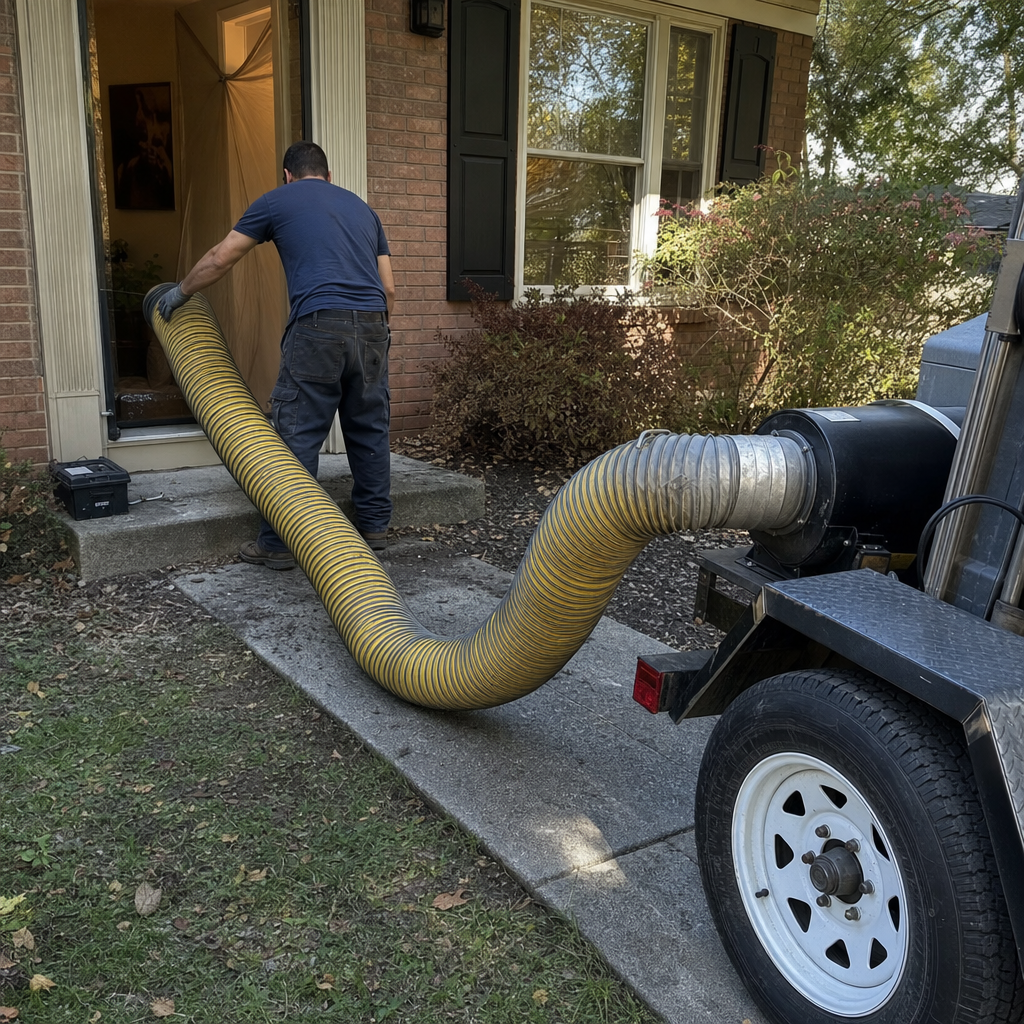
- Negative air pressure containment: We connect a Nikro 5000-CFM negative air machine to the duct system, creating sustained vacuum pressure throughout the entire network. This isn’t a shop vac with a long hose — it’s a dedicated HEPA-filtered collector that maintains -0.02 inches of water column pressure, ensuring dislodged contaminants are captured at the source rather than pushed into your living space. The CFM rating matters: residential systems require minimum 2,000 CFM for adequate containment; our equipment exceeds that threshold significantly.
- Mechanical agitation: We deploy Rotobrush brush-and-vacuum systems through each branch duct, with brush diameter matched to duct size. In Cincinnati’s prevalent 6-inch diameter flexible ductwork (common in 1960s–1990s construction), a 4-inch brush leaves significant wall area untouched; we size appropriately. For sheet metal trunks, we use pneumatic whips and skipper balls that traverse the full length, dislodging adhered material that brushes can’t reach.
- Component-level cleaning: The furnace blower, evaporator coil, and plenum chambers receive dedicated attention. In Cincinnati’s humid climate, the evaporator coil is particularly critical — it’s where moisture condenses and where biological growth often initiates. We clean and inspect; if coil condition warrants, we recommend our HVAC Cleaning in Norwood service for deeper treatment.
- Post-cleaning verification: We re-inspect through access ports, provide photographic documentation, and test system static pressure to confirm airflow hasn’t been restricted by dislodged debris.
The entire process for a standard Cincinnati home takes 3.5–5 hours. Quotes promising 90-minute “whole house” cleanings are performing step 3 only, often with inadequate equipment. We’ve been called to re-clean systems where franchise crews spent 45 minutes with a consumer-grade vacuum attachment, left visible contamination in trunk lines, and charged $299 for the privilege.
Older Homes vs. New Construction: Different Approaches
Cincinnati’s housing stock spans 150 years of construction methods, and duct configuration varies dramatically by era. William Davis adjusts equipment selection and technique based on what we find — there’s no universal approach that works across all local housing.
Pre-1950s homes (Norwood, Hyde Park, Oakley, Columbia-Tusculum):
These properties typically feature original gravity furnace systems converted to forced air, with sheet metal trunk lines and small-diameter branch ducts — often 4–5 inches rather than modern 6-inch standards. The metal is heavy-gauge, durable, but prone to seam separation and internal rust from decades of humidity exposure. Our approach:
- Cut access panels at strategic points (we seal and insulate afterward) since welded seams prevent standard port installation
- Use lower-CFM agitation to avoid damaging aging connections
- Inspect for asbestos-containing duct insulation, still present in some 1940s–1950s Cincinnati systems — we flag for abatement referral rather than disturb
- Evaluate whether duct sealing is needed; original systems often leak 30–40% of conditioned air into basements and wall cavities
We’ve completed numerous jobs in Air Duct Cleaning in Norwood where original 1920s trunk lines were still in service, coated internally with layered dust deposits from coal-to-gas conversion eras. These systems require patience and methodical work — not rushed brush passes.
1960s–1990s homes (suburban expansion areas — Anderson, Colerain, Green Township):
This era brought flexible ductwork, often fiberglass-lined or wrapped, with plastic or wire-supported cores. Flex duct is more vulnerable to crushing, kinking, and internal lining degradation. In Cincinnati’s humidity, we’ve found collapsed sections where moisture weakened the wire support, creating dead zones where contaminants accumulate. Our approach emphasizes gentle agitation, section-by-section inspection, and honest assessment of whether damaged flex duct should be replaced rather than cleaned.
2000s–present construction:
Newer Cincinnati homes typically feature properly sized rigid duct with sealed joints — better baseline conditions, but not immune to construction debris accumulation. We’ve found significant drywall dust, wood particles, and even fastener debris in systems of homes less than five years old. Post-construction cleaning requires particular attention to return air pathways, where coarse debris often settles.
Surface Cleaning vs. Source Removal: Know What You Paid For
This distinction determines whether your duct cleaning investment produces measurable results or merely moves surface dust around. After 14 years and over 1,000 verified reviews, we’ve learned that most Cincinnati homeowners can’t tell the difference — until we show them what was actually in their system.
Surface cleaning removes loose, recently deposited material from easily accessible areas: register faces, the first few feet of branch ducts, visible trunk line sections. It requires minimal equipment — essentially a powerful vacuum with extension attachments. The problem: 60–70% of typical duct contamination adheres to duct walls beyond reach of surface tools, particularly in the horizontal trunk lines where airflow velocity drops and particles settle.
Source removal dislodges and extracts adhered contaminants from the full duct network, including trunk lines, branch ducts, and plenum connections. It requires:
- Negative air pressure containment (minimum 2,000 CFM, HEPA-filtered exhaust)
- Mechanical agitation tools sized to duct diameter
- Access creation at multiple points to reach the full system
- Post-cleaning verification documentation
How to tell which you received:
- Duration: Source removal for a standard Cincinnati home takes 3.5–5 hours. Surface cleaning typically completes in 60–90 minutes.
- Equipment visible: Professional negative air machines are large, wheeled units with 8–10 inch diameter connection hoses — not portable shop vacs. Ask what CFM rating the equipment maintains; legitimate operators know this specification.
- Access points created: Source removal requires cutting or opening access ports in trunk lines. If your technician worked only through existing registers, they didn’t reach the trunk lines where most contamination accumulates.
- Before/after documentation: We photograph interior conditions at multiple points. Companies that won’t show you what they found — and what changed — have something to hide.
- Static pressure measurement: Legitimate cleaning should not increase system resistance. We test before and after; significant pressure changes indicate blocked or damaged ductwork.
The frustrating reality: Cincinnati’s market is saturated with $199 “whole house” specials that perform surface cleaning only. We’ve re-cleaned systems where homeowners paid for “complete” service six months prior, only to find trunk lines still coated with material the original crew never touched. The $199 price isn’t a deal — it’s a different, inadequate service mislabeled as equivalent.
Cincinnati Air Duct Cleaning Costs: What Drives the Range
Quotes for air duct cleaning in Cincinnati typically span $200 to $1,200, with legitimate full-service source removal clustering in the $400–$900 range for standard residential systems. Understanding why quotes vary protects you from both overpayment and inadequate service.
Primary cost drivers in the Cincinnati market:
| Factor | Low-Cost Scenario | Mid-Range Scenario | Premium Scenario |
|---|---|---|---|
| Service type | Surface cleaning only, register-level vacuuming | Full source removal with negative air containment | Source removal plus duct sealing, sanitizing, or repair |
| System size | Small home, 1 system, 8–12 registers | Typical home, 1 system, 15–25 registers | Large home or 2+ systems, 25+ registers |
| Duct accessibility | Modern construction, basement trunk access | Standard mixed construction | Crawl space, attic, or finished basement requiring access creation |
| Contamination level | Light dust, recent maintenance | Moderate buildup, standard interval | Heavy mold, post-renovation, or fire/smoke damage |
| Equipment used | Consumer-grade or portable units | Professional Rotobrush/Nikro systems | Truck-mounted or specialized remediation equipment |
| Typical Cincinnati price range | $199–$350 | $400–$700 | $700–$1,200+ |
The $200–$400 gap between surface cleaning and source removal represents fundamentally different services, not competitive pricing on equivalent work. In our experience across Cincinnati neighborhoods, homes in older areas like Norwood and Hyde Park often require the premium end of mid-range pricing due to access challenges and heavier legacy contamination. Newer construction in suburbs like West Chester or Mason typically falls at mid-range or below.
Be wary of quotes that don’t specify what’s included. We provide itemized scope: number of registers cleaned, trunk line access points, component cleaning (blower, coil), and whether sanitizing or sealing is recommended. Vanguard Air Duct & Vent Cleaning Greater Cincinnati home estimates are always free and specific — call (855) 916-8161 for exact pricing on your system.
Signs Your Cincinnati Home Needs Duct Cleaning
Not every home needs immediate duct cleaning, and not every symptom indicates duct contamination. These are the conditions William Davis has found genuinely warrant service in Cincinnati’s specific environment:
- Visible mold growth inside ducts or on components: In Cincinnati’s humidity, this often appears as dark staining near condensate pans, supply boots in exterior walls, or any duct section with historical moisture intrusion. Musty odors when the system cycles are a reliable indicator even before visual confirmation.
- Excessive dust accumulation: If you’re dusting surfaces weekly and seeing rapid reaccumulation, your duct system may be circulating particulate rather than filtering it. Check your return air filter fit — gaps around the filter frame allow bypass — but persistent issues often indicate duct loading.
- Post-renovation conditions: Construction dust is extraordinarily fine and penetrates standard filtration. We’ve found significant drywall compound and silica dust in systems where homeowners ran HVAC during remodeling. This material is abrasive to blowers and coils; cleaning protects equipment lifespan.
- Pest infestation history: Rodents or insects in ductwork leave biological contamination that vacuuming alone doesn’t address. Cincinnati’s older neighborhoods with mature tree canopy and basement utility access see higher incidence of mouse activity in duct systems.
- Unexplained respiratory symptoms: When occupants experience allergy or asthma symptoms that worsen at home and improve elsewhere, duct contamination is one potential contributor. We don’t make medical claims, but we’ve had numerous Cincinnati customers report symptom improvement following thorough cleaning — particularly when mold or heavy pollen loading was present.
- System efficiency decline: Restricted airflow from duct contamination forces blowers to work harder and reduces effective capacity. If your Cincinnati home isn’t cooling or heating as it once did, duct inspection is a legitimate diagnostic step before assuming equipment failure.
Conversely, these symptoms typically don’t indicate duct cleaning needs: isolated register dust (clean the register), single-room temperature variation (likely damper or insulation issue), or normal filter replacement intervals. We evaluate honestly; if your ducts don’t need cleaning, we’ll tell you and suggest appropriate alternatives.
How Often Should Cincinnati Homeowners Clean Their Ducts
NADCA recommends cleaning every 3–5 years under normal conditions, but Cincinnati’s climate and housing stock modify that baseline. Our 14-year local experience suggests these intervals:
| Home Profile | Recommended Interval | Rationale |
|---|---|---|
| Standard residential, no special factors | 4–5 years | Baseline for moderate climate with standard filtration |
| Homes with pets (shedding breeds) | 3–4 years | Pet dander and hair accelerate filter loading and duct deposition |
| Allergy or asthma sufferers | 3 years | Lower particulate burden supports indoor air quality management |
| Post-renovation | Immediately, then 3–4 years | Construction debris is particularly abrasive and fine |
| Homes with known mold history | 2–3 years with inspection | Cincinnati humidity creates recurring risk; monitoring catches early growth |
| Pre-1970s homes with original ductwork | 3–4 years with condition assessment | Legacy systems accumulate material differently; aging components need monitoring |
These are guidelines, not rigid rules. We’ve cleaned Cincinnati systems that were genuinely clean after 7 years due to excellent filtration and tight construction, and systems requiring intervention after 18 months due to water intrusion events or filter neglect. The key is honest assessment — which is why we inspect before quoting, every time.
For homes with ongoing air quality concerns, we often recommend pairing duct cleaning with upgraded filtration. HVAC Cleaning in Norwood and surrounding Cincinnati areas includes evaluation of whether Aprilaire or Honeywell media filters would provide sustained improvement between cleanings.
Choosing a Duct Cleaning Company in Cincinnati
The Cincinnati market includes owner-operated specialists, national franchise networks, and opportunistic operators who add “duct cleaning” to unrelated service lines. Here’s how to distinguish legitimate providers:
- Verify equipment specifics: Ask brand names and CFM ratings. Professional operators use recognized systems like Rotobrush and Nikro and can explain their negative air containment approach. Vague references to “commercial equipment” or “state-of-the-art tools” without specifics suggest consumer-grade tools.
- Confirm who performs the work: Will the person quoting perform the cleaning? At Vanguard, William Davis leads every job personally — customers get the owner, not a rotating technician. Franchise models often dispatch whoever’s available; quality varies accordingly.
- Request documentation standards: Before/after photos, access port locations, static pressure readings — legitimate operators document their work. If a company can’t show you what they found and what changed, you have no verification of completion.
- Check review patterns: Our 1,049 reviews averaging 4.8 stars accumulated over 14 years demonstrates sustained, repeatable quality. Be suspicious of companies with perfect 5.0 ratings from 15 reviews — volume and duration matter more than perfection.
- Understand the full scope: Does the quote include trunk lines, component cleaning, and access sealing? Or just register vacuuming? Itemized scope prevents the “bait and switch” where low quotes expand dramatically on-site.
- Evaluate service range: Companies offering only cleaning may identify duct damage but lack capability to repair. Our full scope — from cleaning to Dryer Vent Cleaning in Norwood to Duct Repair & Sealing and Air Quality & Sanitizing — means identified problems get resolved in one engagement, not multiple contractor coordination.
Cincinnati’s Better Business Bureau and local consumer protection agencies have documented complaints against low-price duct cleaning operations that performed minimal work, damaged systems, or used scare tactics to upsell unnecessary services. The lowest quote is rarely the best value when measured by actual results.
Common Mistakes to Avoid
- Accepting a quote without system inspection: Legitimate Cincinnati duct cleaning requires evaluating duct configuration, access points, and contamination level before pricing. Phone quotes without inspection are guesses — often deliberately low to secure appointment, with upsell inevitable.
- Confusing duct cleaning with duct sealing: These are distinct services. Cleaning removes contamination; sealing addresses leakage. Some Cincinnati homes need both, but they shouldn’t be sold interchangeably. We assess and recommend separately.
- Ignoring the evaporator coil: In Cincinnati’s humidity, coil condition directly impacts system performance and air quality. Cleaning ducts without inspecting the coil misses a major contamination source and potential efficiency restriction.
- Choosing based on price alone: The $199 “whole house” special performs surface cleaning only, leaving trunk line contamination untouched. When we re-clean these systems, customers have effectively paid $199 for a $0 result — plus the cost of proper service.
- Neglecting post-cleaning filter maintenance: Even thorough source removal can’t overcome ongoing filter neglect. We recommend MERV 11–13 pleated filters for most Cincinnati homes, changed every 60–90 days during high-use seasons.
- Assuming new homes are clean: Construction debris in new Cincinnati construction is remarkably pervasive. We’ve found significant contamination in homes occupied less than one year, particularly when HVAC operated during finishing work.
- Delaying after water intrusion: Cincinnati’s summer storms and basement moisture issues create duct contamination risks that worsen with time. Musty odors or visible moisture near ductwork warrant prompt inspection — mold amplifies quickly in our humidity.
When to Call a Professional
Call for professional duct evaluation when you observe visible mold, experience persistent dust or odor issues, have completed recent renovation, or notice declining system performance. In Cincinnati’s climate, annual HVAC inspection — including duct condition assessment — is prudent preventive maintenance. Vanguard Air Duct & Vent Cleaning Greater Cincinnati offers free estimates in Cincinnati and surrounding communities; William Davis will inspect your system personally, explain findings without pressure, and provide specific scope and pricing. Call (855) 916-8161 to schedule.
Frequently Asked Questions
Professional source removal duct cleaning in Cincinnati typically ranges from $400 to $900 for standard single-family homes, with surface-only services available at lower prices and complex systems or additional services commanding premium rates. The variation reflects system size, duct accessibility, contamination level, and whether services like sealing or sanitizing are included. Call (855) 916-8161 for a free, specific estimate on your home — we inspect before quoting.
Duct cleaning can reduce airborne allergen load when ducts contain significant pollen, mold, or dust mite debris — all common in Cincinnati’s humid, pollen-heavy environment. It’s most effective when paired with quality filtration and humidity control; cleaning alone won’t overcome ongoing source exposure. We’ve had Cincinnati customers report meaningful symptom improvement, particularly following mold remediation or post-renovation cleaning where particulate burden was high.
Thorough source removal cleaning for a standard Cincinnati home with one HVAC system takes 3.5 to 5 hours. Larger homes, multiple systems, or significant contamination extending to components (blower, coil) require additional time. Services promising completion in under 2 hours are performing surface cleaning only, not full source removal.
Properly performed source removal cleaning does not damage intact ductwork. Risks arise with aging flex duct where internal lining has degraded, or when aggressive tools are misapplied to delicate components — scenarios we assess during pre-cleaning inspection. In Cincinnati’s older neighborhoods, we evaluate duct condition before beginning and recommend repair or replacement when cleaning would be counterproductive.
Air duct cleaning addresses the distribution network — supply and return ducts, registers, and grilles. HVAC cleaning extends to the air handler components: blower assembly, evaporator coil, heat exchanger, and plenum connections. In Cincinnati’s humidity, coil condition significantly impacts system performance and air quality; we often recommend combined service for comprehensive results. Our HVAC Cleaning in Norwood service covers this full component scope.
Request before/after photographic documentation from multiple duct locations, verify that access ports were created in trunk lines (not just register cleaning), and ask for static pressure readings showing system resistance hasn’t increased. Legitimate operators provide this documentation routinely; reluctance to share is a red flag. At Vanguard, we show you what we found and what changed — transparency is standard practice.
The Bottom Line
Cincinnati’s unique climate — humid summers, heavy pollen, legacy housing stock — creates duct contamination patterns that demand local expertise, not generic national service templates. Effective cleaning requires professional-grade negative air containment, mechanical agitation sized to your specific ductwork, and honest assessment of whether your system needs cleaning, repair, or upgraded filtration. The lowest quote rarely delivers equivalent results; the critical comparison is what actually happens inside your ducts. With 14 years of Cincinnati-specific experience and over 1,000 verified reviews, we’ve developed approaches that account for local conditions competitors overlook — from Norwood’s original sheet metal to Anderson’s aging flex duct to new construction’s construction debris.
Written by William Davis, Owner & Lead Technician at Vanguard Air Duct & Vent Cleaning Greater Cincinnati, serving Cincinnati since 2012.