
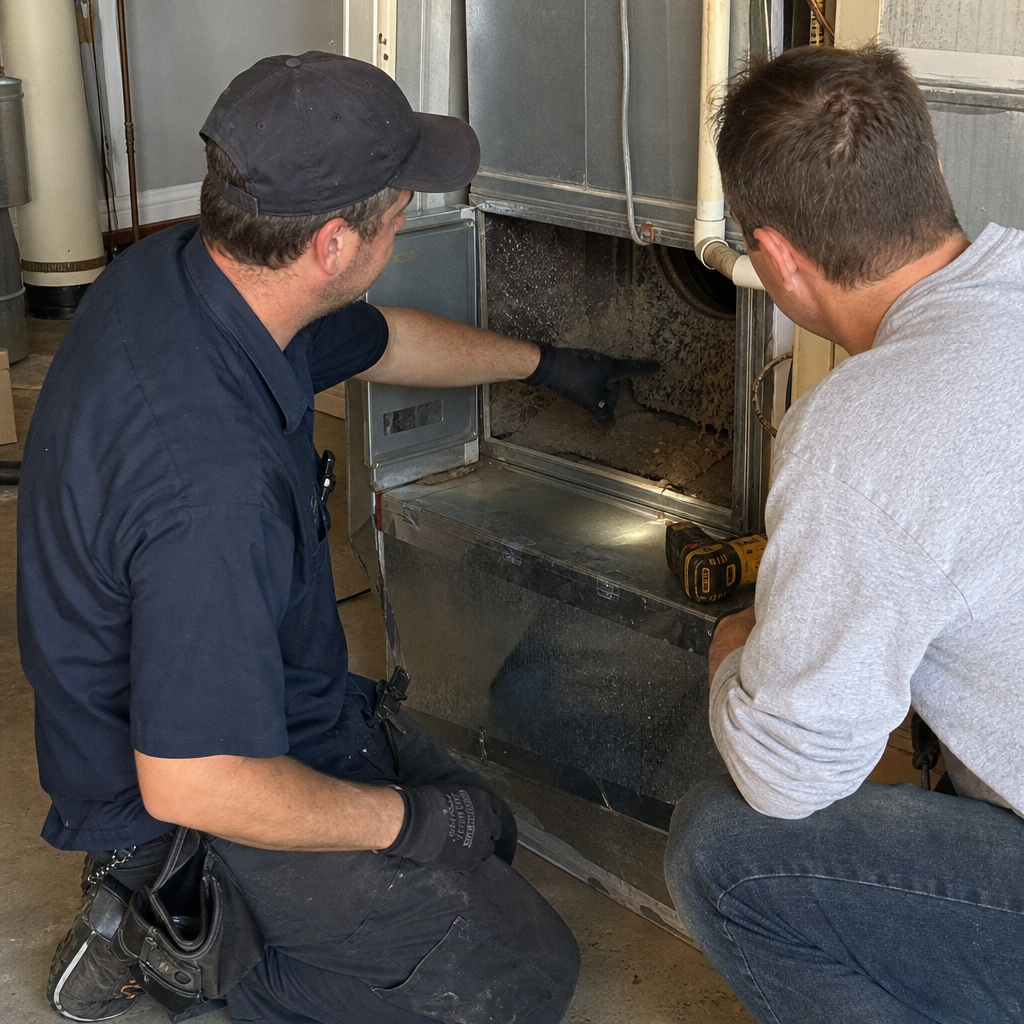
Signs You Need Dryer Vent Cleaning in Cincinnati, OH — Ranked by Severity
If your dryer is taking longer to dry clothes, accumulating excess lint at the exterior vent hood, or running noticeably hot to the touch, you need Dryer Vent Cleaning services. In Cincinnati’s humid Ohio River Valley climate, lint inside long horizontal vent runs absorbs moisture and compacts into dense blockages that escalate quickly from minor restriction to serious fire hazard. Call (855) 916-8161 for a free assessment — William Davis, Owner & Lead Technician at Vanguard Air Duct & Vent Cleaning Greater Cincinnati, will inspect your vent and give you a straight answer on whether cleaning is needed.
Why Cincinnati Homes Face Earlier, Stealthier Dryer Vent Problems
Here’s the pattern we see constantly in Cincinnati’s older neighborhoods: a homeowner notices their dryer “seems a little slower” in February, writes it off as winter humidity, and by July they’re running two full cycles for a single load of towels. The standard warning signs — hot exterior, burning smell, clothes still damp — are actually late-stage indicators. By the time those appear, your vent has been dangerously restricted for months.
The culprit is Cincinnati’s distinctive housing stock combined with our river-valley climate. In neighborhoods like Price Hill, Westwood, Clifton, and Norwood, thousands of brick two-family homes and pre-WWII Italianates have second-floor laundry closets with long horizontal vent runs through plaster wall cavities. These runs were never designed for modern dryers pushing 200+ CFM. Add Cincinnati’s summer humidity — consistently higher than Columbus or Dayton because warm, moist air pools in the Ohio River basin — and lint doesn’t stay loose and fluffy. It absorbs moisture, compacts against elbow joints, and forms dense, almost felt-like blockages that reduce airflow exponentially rather than gradually.
We’ve pulled out blockages in Columbia-Tusculum hillside homes where the lint was so compacted it had the density of compressed insulation. The homeowner thought their heating element was failing. It wasn’t — the vent was roughly 70% blocked, and the dryer was working itself to death trying to push air through a straw.
The Three Stages of Dryer Vent Restriction — And When to Act
Most online guides list warning signs alphabetically or randomly. That misses the point. The progression matters because catching restriction at Stage 1 prevents the danger and equipment damage of Stage 3. Here’s how we rank what we find in Cincinnati homes, from early warning to emergency:
Stage 1: Early Indicators (Action Needed — But Not Urgent)
These signs appear when your vent is partially restricted, typically 20–40% blocked. The dryer still functions, but efficiency is dropping. In Cincinnati’s climate, this stage can persist for weeks or compress to days depending on humidity and run length.
- Excess lint accumulation at the exterior hood cap. Some lint at the termination is normal. But if you’re brushing it away weekly and it returns thickly within days, lint is bypassing your dryer’s internal filter and collecting at the first obstruction point — usually an elbow or sag in the flex duct.
- Fine lint particles on clothing after a full cycle. When airflow is partially restricted, the dryer’s drum can’t maintain proper negative pressure. Fine lint escapes backward through the drum seal and redeposits on your clothes. If you’re finding more lint on dark fabrics than you used to, your vent is telling you something.
- Musty or stale smell on “clean” dried laundry. This one’s specific to Cincinnati’s humidity problem. A partially blocked vent can’t fully evacuate moist air at cycle end. Between loads, humid air from the vent run — or from your damp basement or crawlspace — gets pulled back into the drum. Your laundry smells like the inside of a plaster wall cavity because that’s essentially what you’re smelling.
At this stage, cleaning is straightforward and preventive. Our Dryer Vent Cleaning in Cincinnati service typically removes the restriction in under 90 minutes, and the vent returns to full airflow.
Stage 2: Mid-Stage Warnings (Schedule Cleaning Promptly)
These signs indicate 40–70% restriction. Your dryer is working significantly harder, energy costs are climbing, and fabric wear is accelerating because extended heat exposure breaks down fibers faster.
Clothing requires extended cycle times or multiple cycles to dry completely. This is the sign most homeowners recognize, but in Cincinnati’s long-run homes, it’s already a mid-stage warning — not an early one. If your dryer performed fine through winter but started taking longer in June or July, the culprit is almost certainly humidity-compacted lint in a horizontal run, not a failing heating element. The seasonal trigger is diagnostic: heating elements don’t fail seasonally; blockages do, because Cincinnati’s summer moisture transforms lint’s physical properties.
Visible moisture or condensation inside the drum when you open the door. The vent can’t evacuate humidity fast enough. In river-valley basements where ambient humidity already runs high, this condensation accelerates corrosion on the drum’s internal components and can trigger mold growth in the door seal gasket.
Stage 3: Late-Stage Danger (Immediate Professional Attention Required)
At 70%+ restriction, you’re in fire hazard territory. The Consumer Product Safety Commission attributes roughly 2,900 residential dryer fires annually to lint accumulation, and restricted airflow is the primary mechanism.
Dryer exterior or control panel runs hot to the touch. Your dryer’s thermostat is designed to cycle the heating element on and off based on exhaust air temperature. When airflow is severely restricted, heat can’t escape, the element stays on longer, and the cabinet temperature rises dangerously. If you can’t comfortably keep your hand on the top or side panel during operation, stop using the dryer immediately.
Burning smell during operation. This is lint contacting the heating element or overheated motor windings. It is not “normal” and not something to monitor. Unplug the dryer and call for service.
Automatic shutoff or thermal fuse failure. Modern dryers have thermal fuses that blow when exhaust temperature exceeds safe limits. If your dryer suddenly “died” and a technician replaced a thermal fuse without cleaning the vent, the root cause remains — and the next failure might not be a fuse.
Steam or moisture visible around the dryer cabinet. The vent is so blocked that moist air is being forced backward through gaps in the drum seal or cabinet joints.
What You Can Check Yourself — And What Requires Professional Equipment
We’re not going to walk you through disassembling your dryer’s internal ducting or climbing onto your roof to inspect the termination. Those tasks carry genuine injury risk, and for Cincinnati’s long horizontal runs through plaster walls, visual access is limited anyway.
Here’s what you can safely check:
- Exterior hood cap airflow test: With the dryer running on high heat, hold your hand near the exterior termination. You should feel strong, warm airflow. Weak, intermittent, or barely warm airflow indicates restriction. If the flap barely lifts or doesn’t lift at all, that’s diagnostic.
- Lint accumulation pattern: Remove the exterior hood cap if it’s accessible without ladder work. If lint is packed tightly into the first few inches — not loose and fluffy — you likely have humidity-compacted blockage deeper in the run.
- Flex duct inspection (if accessible): Pull the dryer out carefully and inspect the transition duct behind it. Crushed, kinked, or sagging flex duct is an immediate problem. If it’s the foil or plastic type rather than rigid or semi-rigid metal, replace it regardless — those materials are themselves fire hazards and trap lint at corrugations.
What you cannot check without professional equipment: the interior condition of a long horizontal run through plaster walls, lint accumulation at elbow joints you cannot access, or airflow volume measured in CFM. We use a calibrated anemometer to measure actual exhaust velocity and compare it to the dryer’s rated output. In a properly functioning system, we expect to see 1,200+ FPM at the exterior termination. Readings below 800 FPM indicate significant restriction requiring cleaning.
How Cincinnati’s Housing Stock Complicates Dryer Vent Cleaning
This is where our local experience matters — and where franchise crews with standardized procedures often fall short.
In Cincinnati’s 1890s–1950s housing, dryer vent runs frequently pass through plaster wall cavities that were never designed as duct chases. The original builders ran gravity warm-air “octopus” furnace ducts through similar spaces; when forced-air systems were retrofitted, later trades sometimes repurposed those cavities or ran new vents alongside them. The result: irregular routing, unsupported horizontal runs that sag over decades, and transitions between materials that create lint traps.
We’ve found vent runs in Westwood homes that drop 18 inches from the laundry closet floor, run horizontally for 25 feet with no support brackets, then elbow upward to a second-floor exterior wall. The sag point was packed solid with lint that had absorbed decades of basement humidity. A standard “brush and blow” approach — pushing debris forward with a rotating brush — would have embedded that blockage at the upward elbow, potentially making it worse.
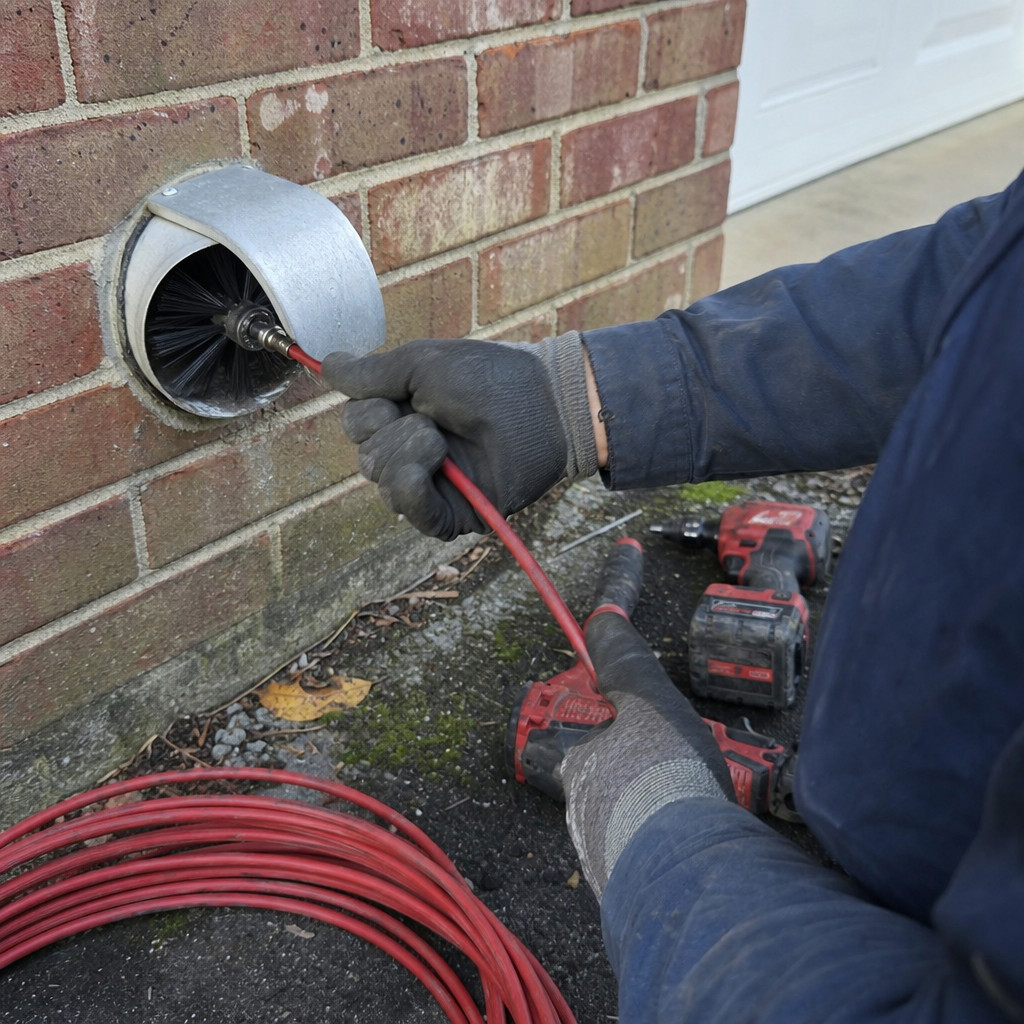
That’s why William Davis uses the same Nikro negative-pressure system for dryer vents that we use for full duct cleaning. We pull debris back toward the machine rather than pushing it deeper into the run. For Cincinnati’s long horizontal routing through plaster walls, this matters enormously. Pushing debris forward risks compacting it at the next obstruction; pulling it backward, with controlled vacuum pressure, removes it completely. We pair this with Rotobrush mechanical agitation where accessible, but the extraction direction is what protects your vent’s integrity.
In hillside neighborhoods like Mount Lookout and parts of Anderson Township, we also encounter walk-out basements where vent runs pass through slab-level chases exposed to sharp seasonal temperature swings. Condensation forms on the vent’s exterior surface in summer, then that moisture migrates inward through microscopic gaps in joints, accelerating lint compaction from the outside in. These runs require particular attention to joint sealing after cleaning — a step many services skip.
What Professional Dryer Vent Cleaning Actually Involves
When you call Vanguard Air Duct & Vent Cleaning Greater Cincinnati at (855) 916-8161, here’s what happens:
William Davis arrives — not a subcontractor, not a rotating crew member — and inspects your vent routing, measures airflow, and identifies access points. For Cincinnati’s complex older homes, this inspection is itself diagnostic. We’ve found vents routed through chimney flues, shared with bathroom exhausts, or terminating under decks where code violations compound the blockage risk.
Cleaning proceeds based on what we find. For standard accessible runs, we use Rotobrush mechanical agitation with simultaneous Nikro negative-pressure extraction. For long horizontal runs with suspected compacted blockage, we may use specialized compressed-air tools that break up dense lint without damaging the vent walls — critical for thin-walled galvanized duct common in older Cincinnati homes.
After cleaning, we measure again. Our target is restoring 90%+ of rated airflow, verified with the same anemometer. We also inspect and repair transitions, replace hazardous flex duct with semi-rigid metal where needed, and ensure the exterior termination has proper backdraft damper function — important because Cincinnati’s wind patterns can drive rain and humid air backward into a failed damper.
Clean ducts aren’t glamorous — but neither is replacing a blower motor because it was choking on years of buildup. The same principle applies to your dryer: a $200–$350 cleaning prevents $800+ in premature heating element, motor, or control board replacement, not to mention the unquantifiable cost of a house fire.
When to Call — And What It Costs
Our recommendation is straightforward: if you’re seeing any Stage 1 sign, schedule cleaning within the month. If you’re at Stage 2, within the week. Stage 3 means stop using the dryer and call today.
For Cincinnati-area dryer vent cleaning, typical investment ranges depend on complexity:
| Service Level | Typical Range | What It Covers |
|---|---|---|
| Standard dryer vent cleaning (accessible run, single story) | $150 – $225 | Full mechanical cleaning, airflow test, exterior termination inspection |
| Complex routing (second-floor laundry, long horizontal run, multiple elbows) | $225 – $350 | Extended access, compressed-air agitation for compacted blockage, joint inspection and basic sealing |
| Vent repair/replacement (damaged duct, improper materials, code violations) | $200 – $500+ | Material and labor for duct replacement, proper support brackets, code-compliant termination |
We provide upfront pricing before any work begins — no surprises, no upsell pressure. Estimates are free, and we’ll tell you honestly if your vent doesn’t need cleaning yet.
FAQs
If the problem started or worsened specifically in summer, it’s almost certainly a clogged vent — heating elements don’t fail seasonally, but Cincinnati’s humidity causes lint compaction that does. A failing heating element typically produces no heat at all or intermittent heat regardless of season; a clogged vent produces heat that can’t escape, making the dryer run hot but clothes stay damp. Call (855) 916-8161 and we’ll diagnose it properly — estimates are free.
For a short, straight, accessible vent with no interior wall routing, a homeowner with proper tools can sometimes achieve adequate cleaning. But Cincinnati’s older housing stock rarely has vents that simple — long horizontal runs through plaster walls, multiple elbows, and humidity-compacted blockages require professional-grade extraction equipment and the experience to avoid damaging fragile galvanized duct or embedding debris deeper. The cost of professional cleaning — from the Best Dryer Vent Cleaning in Cincinnati, OH — is typically recovered in 6–12 months through reduced energy bills and extended dryer lifespan.
For typical Cincinnati households with standard usage, every 12–18 months is prudent. But several local factors shorten that interval: homes with second-floor laundry and long horizontal runs; households that do more than five loads weekly; vents with multiple elbows or sagging unsupported sections; and any home where you’ve observed Stage 1 warning signs previously. After our first cleaning, we’ll give you a specific recommendation based on your vent’s routing and your usage patterns.
Yes — restricted airflow causes the heating element to overcycle, raising temperatures until lint (which is highly combustible) ignites. The CPSC reports approximately 2,900 dryer fires annually, causing an estimated $35 million in property loss, and lint accumulation is the leading cause. In Cincinnati specifically, the humidity-compaction factor means blockages can become severe before obvious warning signs appear, making proactive cleaning particularly important. If your dryer exterior runs hot or you smell burning, stop using it immediately and call (855) 916-8161.
Ready for a Straight Assessment?
If you’re noticing longer dry times, excess lint, or any of the warning signs we’ve described, don’t wait for the situation to escalate. Vanguard Air Duct & Vent Cleaning Greater Cincinnati offers Affordable Dryer Vent Cleaning in Cincinnati, OH, with no-pressure inspections throughout the area — William Davis will show up personally, measure your actual airflow, and tell you exactly what you’re dealing with. Call (855) 916-8161 for a free estimate.
Written by William Davis, Owner & Lead Technician at Vanguard Air Duct & Vent Cleaning Greater Cincinnati, serving Cincinnati, OH.