
Trane Air Duct Cleaning in Reading, OH | Vanguard Air Duct & Vent Cleaning Greater Cincinnati
Trane air duct cleaning in Reading, OH typically runs $350–$650 for a complete system service, depending on whether your home has original gravity-furnace ductwork that was retrofitted for forced air. We’re Vanguard Air Duct & Vent Cleaning Greater Cincinnati — Trane specialists and an independent service provider, not a factory-authorized dealer — and we’ve spent 14 years learning how Trane equipment behaves inside Reading’s unique mid-century housing stock. William Davis, our owner and lead technician, handles every job personally. Call (855) 916-8161 for a free estimate.
Why Reading Residents Choose Us for Trane Service
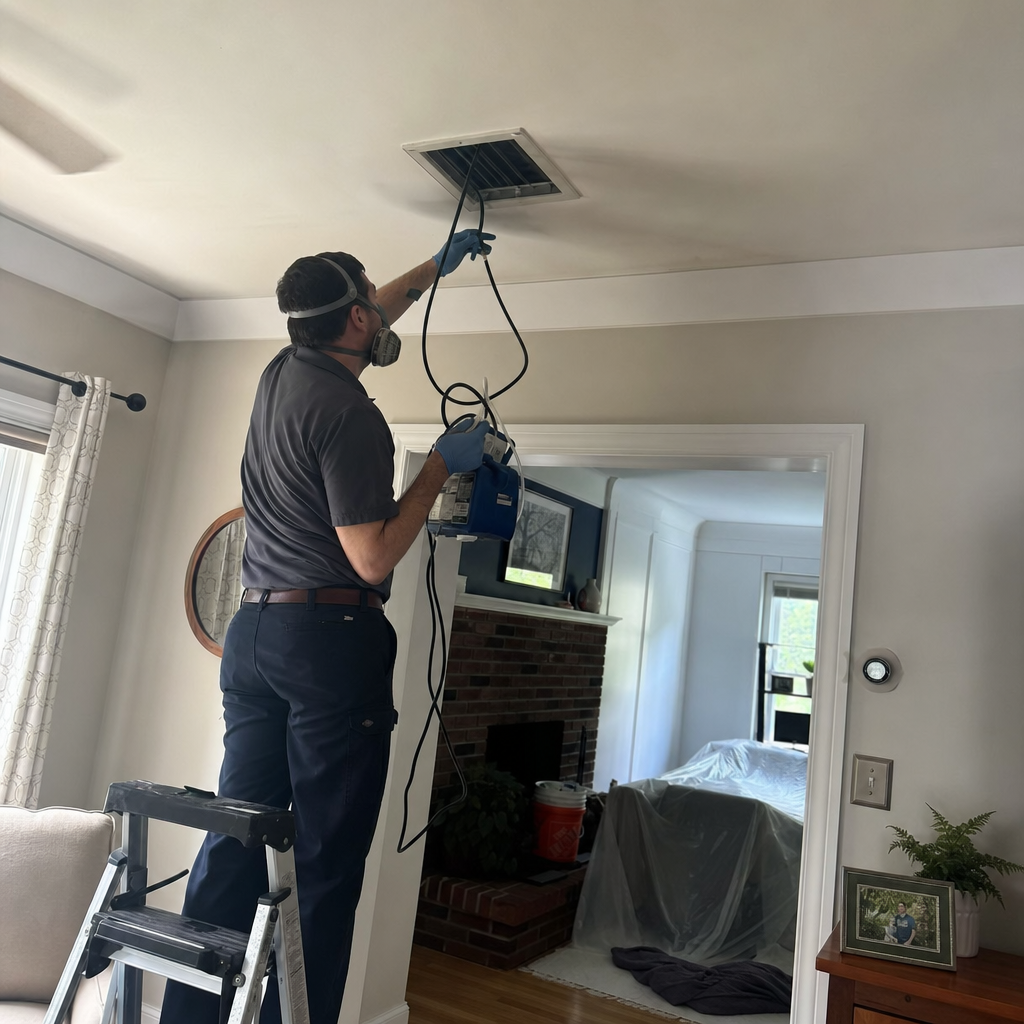
William Davis leads every job personally. That’s not marketing — it’s how we’ve operated for 14 years and over 1,000 verified reviews. When you hire Vanguard Air Duct & Vent Cleaning Greater Cincinnati for your Trane system in Reading, you get the business owner on-site with professional-grade Rotobrush and Nikro equipment, not a rotating subcontractor with a shop-vac and a commission quota.
We know Trane’s quirks. The odd-size filter racks on the XV80. The variable-speed ECM modules that don’t tolerate moisture. The Hyperion air handlers with their proprietary cabinet dimensions. William learned the mechanical fundamentals through Cincinnati State Technical and Community College’s HVAC/R program, then spent years specializing in duct and vent systems specifically. He’s cleaned Trane equipment in Reading’s postwar bungalows, in the ranch homes along Cooper Avenue, and in the converted gravity-furnace houses where the “ductwork” is sometimes a block wall with a blower attached.
Our 1,049 reviews averaging 4.8 stars reflect something simple: we show up, we know what we’re looking at, and we don’t invent problems to sell you. From cleaning to repair to sanitizing — one call, complete duct care.
Common Trane Air Duct Cleaning Problems We Solve in Reading
- Short-cycling scroll compressors in oversized ductwork. Reading’s 1940s–1960s ramblers were built for gravity furnaces, not forced-air blowers. When a Trane XB13 or XV80 gets paired with trunk lines sized for passive airflow, the compressor cycles on and off too frequently. We measure static pressure and often find the system was never re-ducted properly during conversion.
- Evaporator coils clogged with decades of plaster dust. Trane’s Low-E series coils sit downstream of return air that, in Reading homes, may have flowed through open wall chases since the Eisenhower administration. That 60-year-old plaster and lath debris compacts on the fins. We flush aggressively — and show you the video.
- Overheating XR-series blower motors from restricted panned-joist returns. Reading bungalows commonly used floor joist cavities as return passages. The openings are too small, the runs are too long, and the Trane blower motor works overtime. We find motors running 20–30 degrees above spec.
- ECM module failure from Mill Creek valley humidity. Reading sits low in the Mill Creek corridor, where ambient moisture infiltrates unsealed duct joints year-round. Trane’s variable-speed ECM controllers in the XV80 don’t forgive moisture intrusion — we’ve replaced modules that failed prematurely because the return plenum was pulling wet basement air through a gap you could slide a hand into.
- Coal-chute access panels leaking return air to the outside. Reading’s 45215 neighborhoods include homes where original coal chutes were never fully sealed during furnace upgrades. We regularly find these chutes feeding Trane air handlers unconditioned, humid outside air — sometimes with rodent traffic included.
Trane Service in Reading: What Local Conditions Mean for Your Equipment
Reading’s position in the Mill Creek valley creates a localized humidity problem that upland suburbs like Evendale or Trane service in Sharonville simply don’t replicate. The 45215 ZIP sits lower than its neighbors, and that elevation difference translates to measurable moisture infiltration into older duct systems. For Trane owners, this matters because Trane’s variable-speed electronics — particularly the ECM modules in XV80 furnaces and Hyperion air handlers — are sensitive to sustained humidity exposure.
Here’s the specific issue we see: Reading’s housing stock includes dozens of homes where the “ductwork” incorporates original coal-chute access panels now leading directly to Trane air handlers. These chutes were never designed for conditioned airflow. They pull humid valley air into the return side, saturating the blower compartment and corroding electrical connections. We regularly seal these chutes with mastic to stop the Mill Creek valley humidity from degrading components that cost $400–$800 to replace. It’s not a repair most duct cleaners even look for — they don’t know the local housing history, and they don’t open the plenum to check.
On Vermont Avenue, we cleaned an 18-year-old Trane XV80 in a 1953 ranch that had its return air running through a block-and-mortar wall chase. Our video inspection found compaction of insulation fibers and rodent debris from the unlined passage. We disassembled the chase section, shop-vacuumed all cavities, then sealed every mortar joint with mastic — supply temps rose from 102°F to 125°F by the time we buttoned up. That’s the difference between surface-level cleaning and understanding how Reading’s houses actually work.
Trane Models & Products We Service in Reading
We clean and service Trane XV80 variable-speed furnaces, Trane XB13 single-stage air conditioners, Trane Hyperion air handlers, and Trane S9V2 two-stage systems throughout Reading. These units share a common vulnerability in this market: they were often installed into duct systems never engineered for their airflow requirements.
Our parts approach is straightforward. We stock OEM Trane filters and blower motors because odd sizes — 20x25x4, 16x25x5, and the Hyperion’s proprietary cabinet filters — aren’t reliably matched by aftermarket brands. For capacitors and contactors, we’ll fit quality aftermarket components when Trane OEM is backordered. We’re direct about repair versus replace: if we find a cracked heat exchanger on a 2000-era XV80, we’ll tell you it’s time for a new furnace, not a duct cleaning.
Our Rotobrush and Nikro systems handle the full scope — video inspection before we start, mechanical agitation through the trunk lines, and HEPA-contained debris removal. For Reading’s older homes, we also carry mastic and sealant for duct sealing work that factory-assembled systems rarely need.
Trane Service Pricing in Reading
Complete Trane air duct cleaning in Reading typically ranges from $350 to $650, with most 1,500–2,500 square foot homes falling in the $450–$550 range. What drives the cost:
- System accessibility: Homes with finished basements or sealed plenums take longer to access.
- Return chase remediation: If we find open wall cavities or coal chutes feeding your Trane unit, sealing adds material and labor.
- Number of supply/return vents: Reading’s larger ranch homes often have 12–18 vents versus 8–10 in smaller bungalows.
- Air handler cleaning included: We always recommend cleaning the Trane blower wheel and evaporator cabinet — it’s where the real buildup lives.
Our free estimate includes a full video inspection of your trunk lines and blower compartment. No charge to look, no pressure to commit. Call (855) 916-8161 and we’ll schedule a time that works — William Davis handles the estimate personally.
Serving Reading, OH — Our Local Coverage Area
We’re based in the Reading area and know this community well. Use the map below to see our service coverage — if you’re nearby, we can almost certainly help.
FAQs — Trane Air Duct Cleaning in Reading
No — we’re an independent service provider with 14 years of hands-on Trane experience. We’re not affiliated with Trane’s dealer network, which means no factory warranty work, but also no corporate pricing structure or upsell quotas. We source OEM Trane parts through independent HVAC distributors and charge fair rates for labor. Call (855) 916-8161 if you want an honest assessment of what your Trane system actually needs.
Because many 45215 homes used open wall cavities and floor joist channels as return air pathways when gravity furnaces were converted to forced air. These passages were never lined — they pulled air through 60-year-old plaster and lath, construction debris, and sometimes insulation fibers for decades. Your Trane blower has been circulating that material since installation. We find it compacted on blower wheels, evaporator coils, and in the deepest sections of trunk lines.
Yes — but we inspect first. Original ductwork from the gravity-furnace era is often unlined sheet metal with lead-sealed joints or asbestos-containing materials. We run a video camera before any agitation cleaning. If we find deteriorated duct liner or friable material, we’ll recommend remediation by a licensed abatement contractor rather than proceed with mechanical cleaning. Safety first — always.
Often, yes — especially if you’re seeing humidity damage to the Trane ECM module or blower compartment. Unsealed joints in Mill Creek valley homes pull measurable moisture into the system. We use mastic and foil tape (never duct tape) on accessible joints, and we’ve seen supply temperature improvements of 15–25 degrees after sealing combined with cleaning. The 1953 ranch on Vermont Avenue is one example. Call (855) 916-8161 for an inspection — we’ll show you exactly where your system is leaking.
Cleaning helps, but it doesn’t change physics. If your Trane blower is choking through a 6-inch panned-joist return that should be 12 inches, debris removal only gets you partway there. We measure static pressure and airflow before and after cleaning. If the duct structure itself is the restriction, we’ll tell you — and we can quote duct repair or return modification through our Duct Repair & Sealing service. Clean ducts aren’t glamorous — but neither is replacing a blower motor because it was choking on years of buildup.
Most Reading bungalows with retrofitted Trane systems use 16x25x1 or 20x25x4 filters, but we’ve found oddball sizes in nearly every converted gravity-furnace home. The XV80 often has a factory 20x25x5 media cabinet; some Hyperion air handlers take proprietary sizes. We measure your existing filter rack during our free estimate and stock common Trane sizes on our truck. Call (855) 916-8161 — we’ll bring the right filter and show you how to check it yourself between visits.
Service Areas Near Reading
We serve Reading’s 45215 ZIP directly, with regular calls from neighboring Norwood — where William Davis grew up — as well as Newport, Bellevue, and Trane service in Springdale. We’re typically 15–20 minutes from Reading to most of Hamilton County, and we schedule same-day estimates when the day’s routing allows.
Book Your Trane Service in Reading Today
William Davis leads every job personally, from the first video inspection to the final mastic seal. We’ve got 14 years, thousands of systems cleaned, and over 1,000 verified reviews backing our work. If your Trane system is running through decades-old ductwork in a Reading home, we’ll tell you exactly what we’re seeing and exactly what it’ll take to fix it — no more, no less. Call (855) 916-8161 for your free estimate.
Written by William Davis, Owner & Lead Technician at Vanguard Air Duct & Vent Cleaning Greater Cincinnati, serving Reading and the Greater Cincinnati area since 2010.